A German Takes a Loan at 3.7%, and You at 6% or More. Where This Difference Really Comes From
Jun 11, 2026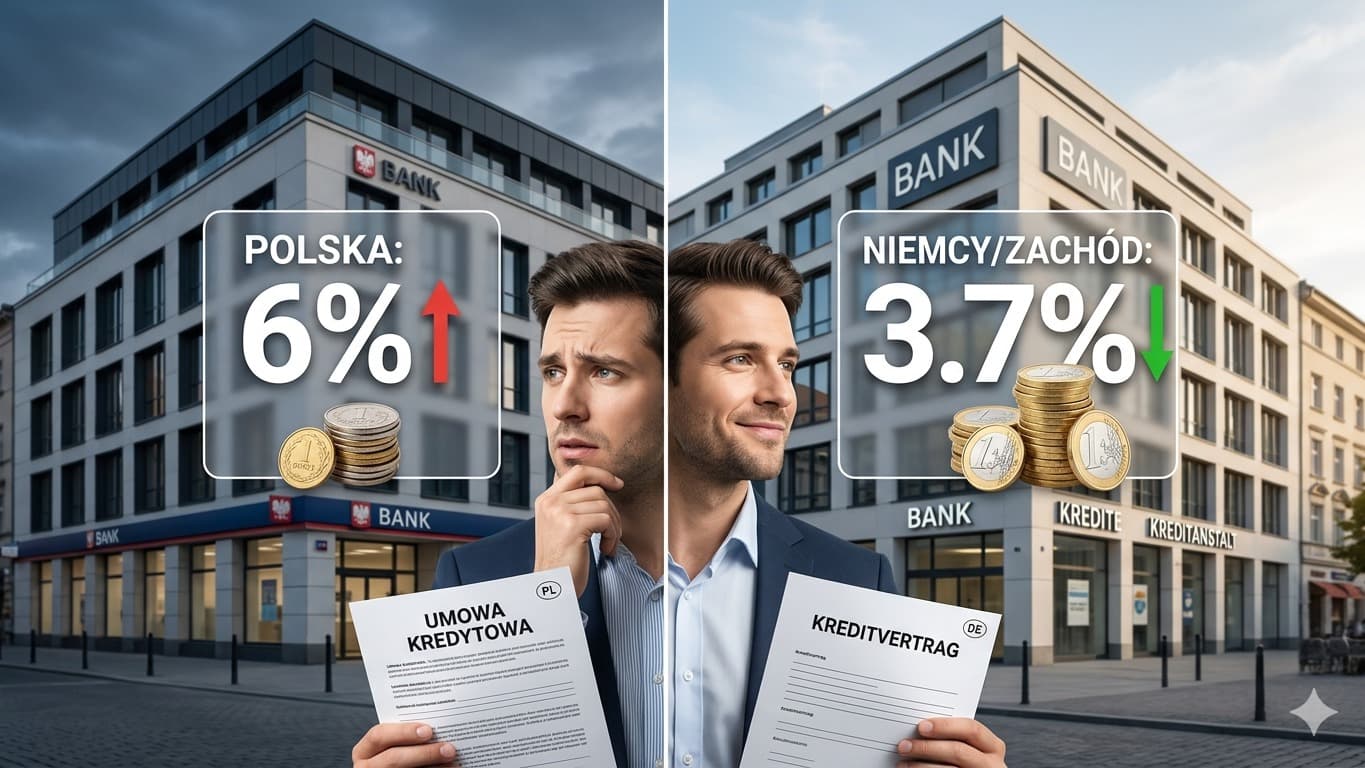
Why a loan in Poland is more expensive than in the West
A German takes a loan at 3.7%, and you at 6% and more. Where does this difference really come from?
KEY DIFFERENCE IN LOAN PRICE My sister in Germany pays 3.7% for a loan. And I in Poland - 6% and more. We hear this sentence all the time. And indeed – the difference is huge. It's easy to conclude from this that Polish banks are simply ripping people off. But that's not true – and more importantly, such an answer explains nothing. To understand where this difference really comes from, you have to go back more than two hundred years.
How it started, and it was a really long time ago
Let's go back to the 18th century. Prussia, 1769. The country is recovering from the devastating Seven Years' War, and landowners lack money to rebuild their estates - and banks are afraid to lend for longer. The idea attributed to King Frederick II dates from this period: instead of lending from its own pocket, the institution issues a special paper, secured on the borrowers' land and real estate. This is how the prototype of the mortgage bond was born - in German Pfandbrief.
The idea turned out to be so good that it spread across Europe. France introduced its own law on mortgage bonds in 1852. Denmark built an entire housing finance system around them, which remains one of the largest in the world today. Germany refined the rules with the Act of 1899 - and since then, through two world wars, hyperinflation, and the division of the country, this mechanism has operated continuously.
INSTITUTIONS BUILT OVER GENERATIONS The cheap, long, fixed installment in the West did not fall from the sky. It is the fruit of an institution that has been built and refined for over 250 years.
What are mortgage bonds - as simply as possible
Imagine a bank that has a certain problem.
You come to it for a loan: you want to borrow a large amount for 25 years, with a fixed installment. The bank would be happy to grant it to you, but where is it supposed to get that money? It doesn't keep cash stored in a vault for a quarter of a century. It must borrow it from somewhere – preferably cheaply, for a long time, and safely. Because since it promised you a fixed installment for years, it also needs money "permanently", not something that someone can take away at any moment.
And here comes the mortgage bond. It's simply a paper that the bank sells to investors to get the money for your loan. It tells them more or less like this: Lend me money. I will pay you a fixed percentage for years. And so that you are not afraid that you won't get it back - I am putting the mortgages of my clients as security under this paper. If my bank ever failed, you have priority to these apartments. Your money is safe.
THE ESSENCE OF MORTGAGE BONDS Investors – pension funds, insurers, but also individual investors - look for a place where they can safely and long-term invest their money. A mortgage bond is like a vault for them: certain, secured on real real estate.
Why this lowers your installment
Since the paper is so safe, investors are satisfied with a small profit - they don't take risks, so they don't demand a high percentage. And since the bank borrowed cheaply from investors, it lends cheaply (but more expensively than it borrowed itself) to you. It adds its margin.
A German bank thus has a cheap "wholesale" of long money. And that is why it can give the sister from our example a fixed 3.7% for years.
Why we practically don't have this
And here we come to the Polish problem.
Poland also has mortgage bonds - except the market is microscopic. It is only about 0.2% of the European market. For comparison: the German Pfandbrief is one of the largest segments of the bond market there. We have barely a trace of it.
So where do Polish banks get the money for loans? Primarily from current deposits - that is, from the money that clients keep in accounts and deposits.
RISK OF MATURITY MISMATCH A deposit is short money - the client can withdraw it at any time. And a mortgage is an obligation for 25-30 years. The bank thus finances something very long with something very short. It's like building a bridge with planks that someone can take away at any time. Such a mismatch is risky, and someone always pays for the risk. In this case, the borrower pays it, in the higher price of the fixed interest rate of the loan.
Since the bank does not have long, cheap financing from mortgage bonds, it must deal with the risk of a fixed rate differently. It does this through a transaction called IRS – it is behind the valuation of the fixed interest rate in Polish banks. To simplify: the bank buys protection against a rate hike on the market and adds its cost to your offer. The more expensive this protection costs, the higher the fixed rate.
This is why the Polish fixed rate can grow even when the central bank does not move rates – because it follows the market, not the Monetary Policy Council. In a system based on a mortgage bond, this risk is taken on by the capital market. Here, with financing from deposits, it is shifted to the borrower.
Short market for the fixed rate
The lack of cheap, long-term financing has its consequences. In Poland, a "fixed rate" is usually only 5 years - then the interest rate is set anew anyway. For comparison: in the USA the standard is 30 years, in France 20-25, in Germany 10-15. We offer the shortest fixed rate in this lineup - because our financial market is not yet ready for it.
It's not a matter of bad will. A Polish bank is not worse than a German one - it simply does not have a cheap wholesale of long money behind it, which the Germans have been building for over two centuries. It is an institutional lag that Poland is only beginning to make up for.
Second reason: the zloty costs more than the euro
Mortgage bonds are not everything. There is another, equally important reason, and it lies in the currency itself.
Every currency has its "price of money", i.e., the level from which all loans in a given country start. It is determined by the central bank with its interest rate, and the market adds a risk assessment to it. And here the zloty by definition loses to the euro.
The reason is simple: the euro is one of the main currencies of the world, used by hundreds of millions of people in the largest, most stable economies. An investor who lends in euros feels safe and is satisfied with a low interest rate. The zloty is a much smaller currency - more exposed to exchange rate fluctuations, inflation, and political turmoil. For this risk, the investor demands a higher payment.
What this means in practice
Poland today has an interest rate of 3.75%, and the eurozone 2.0%. Right at the start, money in zlotys is thus nearly 1.75 percentage points more expensive than in euros - before the bank even adds its margin. On top of that is the higher Polish inflation, which keeps rates high. A German bank is not better - it simply borrows a cheaper, safer currency.
INFLUENCE OF CURRENCY ON LOAN COST The currency change itself can change the picture: a German loan is cheaper not because the bank there is more honest, but because the euro is simply cheaper and safer money than the zloty. No Polish bank is able to let this difference go. It pays a higher price itself for financing in zlotys.
And finally, geopolitics enters, affecting everyone at once
There is one more element that explains why the fixed rate has been getting more expensive lately even where loans are cheap.
The price of a fixed rate does not follow the central bank. It follows the market - and the market reacts to what is happening in the world. In recent weeks, tensions around Iran and the rise in oil prices have boosted inflation expectations, and with them bond yields. And this is not just in Poland, but all over the world. German financial services wrote directly about the seesaw of rates in the rhythm of headlines from the Middle East.
The effect is visible in the current interest rates for a new loan for June 2026:
| Country | Interest Rate | Period and type of rate |
|---|---|---|
| France | 3.0% – 3.5% | Fixed rate 20 - 25 years |
| Germany | approx. 3.7% | Fixed rate for 10 years |
| Poland | approx. 6.0% and more | Fixed rate for 5 years |
| USA | approx. 6.5% | Fixed rate for 30 years |
And here a surprise awaits us. A new loan in the USA costs more today than in Poland. So where does the famous "in America they have 3%" come from? Because those are loans from a few years ago. An American who took out a loan in 2021 at 3% has those 3% frozen for the full 30 years - regardless of what is happening or will happen in the world.
STRENGTH OF LONG-TERM FIXED RATE This is the strength of a long fixed rate: it protects those who caught it cheap, although it does not lower the price for new customers. You can see here exactly what we started with: it's not about which bank is more honest. It's about how the entire loan financing system is built and who managed to get a cheap fixed rate before the world became more expensive.
What this means for you
The difference between a Polish and a German loan does not come from greed or bad luck. It is made up of three things: own currency, which is more expensive and riskier than the euro, the historical dominance of the variable rate, and the lack of a developed mortgage bond market, i.e., a cheap source of long money, which the West has been building for over 250 years.
For you, as a borrower, there is one practical conclusion from this: since the loan price is influenced by mechanisms over which you have no influence, it is all the more important what you do have an influence on - i.e., a conscious choice between a fixed and variable rate and choosing the right offer.
Wondering which form of interest is best in your situation? A credit expert at NaszEkspert.pl will analyze your case and calculate the real...
Talk to a mortgage expert - for free
Experts on NaszEkspert.pl respond within 4 hours