
Rates Stay Put, but the Fixed Installment Rises. What's Really Happening in the Mortgage Market in 2026
Jun 8, 2026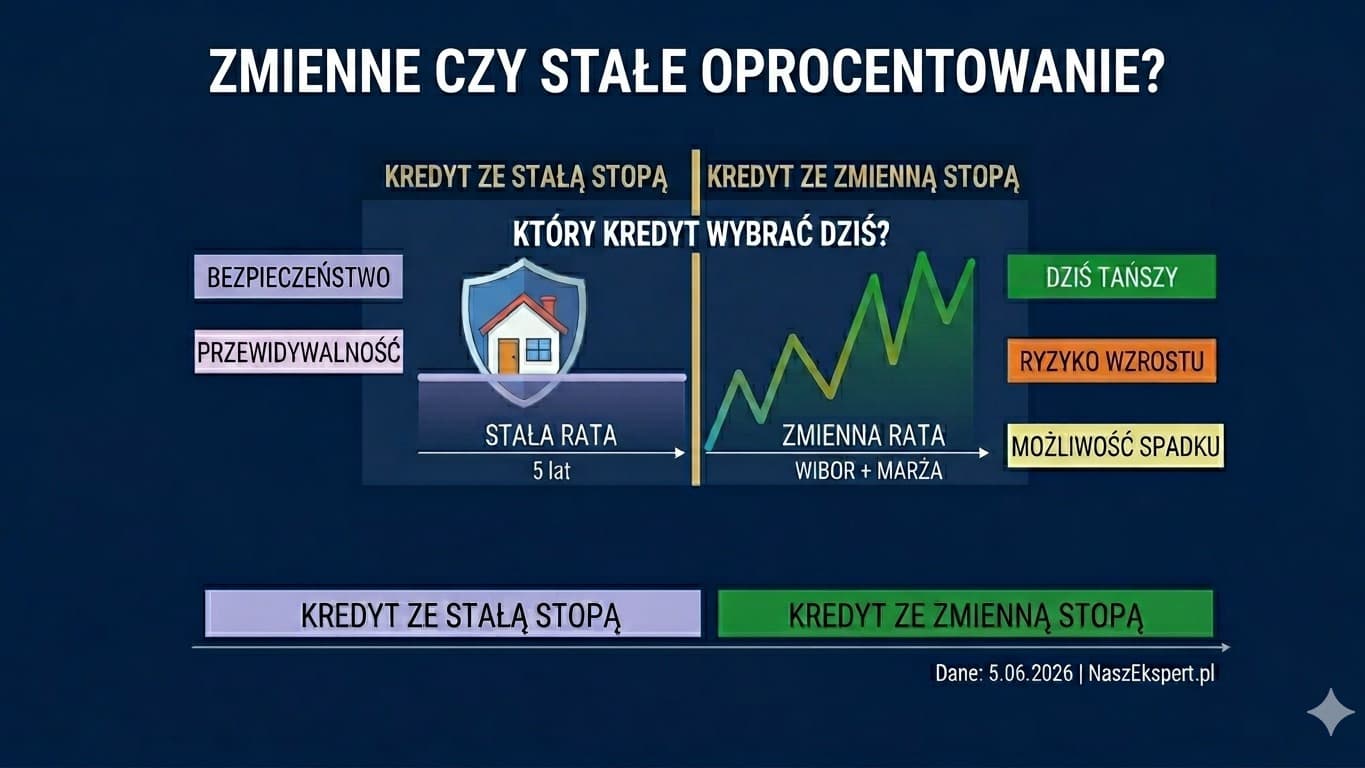
Fixed rate is expensive despite the lack of a rate hike. Why the difference?
The Monetary Policy Council (RPP) did not raise interest rates. WIBOR is standing still. And yet, fixed-rate mortgages are expensive today. In many banks, more expensive than even in the spring. For borrowers, this may look like a contradiction. Since the NBP does not change rates and WIBOR remains stable, why is the fixed installment still so high? The answer lies not in the RPP's decisions, but in how the market prices fixed-rate mortgages.
Most important The fixed mortgage interest rate does not depend directly on the RPP's decisions. Banks price it based on the market cost of hedging interest rates, i.e., the IRS index.
RPP maintained rates, but fixed loans did not get cheaper
On June 2, 2026, the Monetary Policy Council maintained the reference rate at 3.75%. The decision did not surprise the market. Especially since CPI inflation in May fell to 3.1%, clearly below earlier forecasts. The last rate cut took place in March. The next RPP meeting is scheduled for July 7–8, 2026.
At the same time, WIBOR remained practically unchanged. According to GPW Benchmark data of June 3, 2026, WIBOR 3M was around 3.85%, and WIBOR 6M was about 3.93%. At first glance, the situation looks calm. NBP rates unchanged. WIBOR without major movement. And yet, fixed-installment loans remain expensive.
Why is the fixed rate expensive if the RPP doesn't change rates?
The fixed interest rate is not set directly by the Monetary Policy Council. It is set by the market. The key here is the IRS index, i.e., Interest Rate Swap. In simple terms, it is the market price for "locking in" a fixed interest rate for several years ahead. When a bank offers a fixed-rate mortgage, it must protect itself against the risk of interest rate changes in the future. It does this through IRS transactions. The more expensive such protection is, the higher the fixed interest rate that later goes into the bank's offer.
That's why a fixed loan can get more expensive even when the RPP does not raise rates The central bank influences the level of interest rates in the economy, but the fixed interest rate of mortgages also depends on market expectations, bond yields, risk premiums, and the global situation.
What happened in the spring of 2026?
In mid-May 2026, the 5Y IRS touched the level of 4.79%. This translated into bank offers. Between March and May, fixed interest rates in many banks increased by 0.2 to even 0.8 percentage points. This was not directly due to NBP decisions. The increase was primarily due to market and geopolitical factors: the conflict in the Middle East, rising oil prices, and higher bond yields. These are factors that the Polish central bank has no direct influence on.
The credit market has split in half
In 2026, there is a clear division between fixed-rate and variable-rate loans. The fixed rate remains expensive because it depends on the market IRS. The variable rate remains more stable because it is based on WIBOR, which follows NBP rates more closely.
In practice A variable-rate loan may look cheaper at the start today, but it transfers the risk of installment changes to the borrower.
A fixed-rate loan gives more predictability, but currently, you have to pay more for this predictability.
Record in the mortgage market, but with an important caveat
April 2026 brought a historical record in the housing loan market. According to BIK, the value of granted mortgages amounted to 13.65 billion PLN, which is 67% more year-on-year. At first glance, it looks like a strong boom in the housing market. But the structure of this number shows something more.
According to the AMRON-SARFiN report, the share of refinancings in new loans increased over the year from 8% to 28%. BIK confirmed this direction in a more recent monthly reading. In April, refinancings already accounted for over 30% of new lending. This means that a large part of the "boom" is not due to the purchase of new apartments. In many cases, it is the same debt moved to another bank on more favorable terms.
This is an important distinction The high value of new mortgages does not necessarily mean only new demand for apartments.
An increasingly large part of the market consists of refinancings, i.e., transferring already existing loans to other banks.
Fixed or variable rate in 2026?
There is no single correct answer for everyone. The choice between a fixed and variable rate depends on your financial situation, plans for the coming years, and risk tolerance. A fixed rate provides predictability. It protects against installment increases and facilitates household budget planning. Its disadvantage is that today it can be more expensive and does not automatically allow you to benefit from possible future rate cuts. A variable rate may be cheaper at the start. It also allows you to benefit faster from a drop in interest rates. At the same time, it means that the risk of installment increases remains on the borrower's side.
A simple rule If peace of mind and predictability are most important to you, a fixed rate may be a safer choice.
If you accept the risk of variable installments and are counting on a further drop in the cost of money, a variable rate may be more attractive.
When should you consider refinancing?
If you are repaying a loan taken out 2–3 years ago at a high fixed interest rate, refinancing may lower your installment. However, it is not automatically profitable in every case. You need to calculate the total cost of transferring the loan, the new margin, the interest rate, the remaining repayment period, commissions, and possible additional bank costs. Only then can you realistically assess whether changing the bank will actually bring savings.
Don't just look at the lower installment Refinancing should be evaluated based on the total cost of the loan, and not solely on the monthly installment.
A lower installment may look attractive, but profitability is determined by all costs together.
If you are repaying a high-interest mortgage, check whether mortgage refinancing in Poland could reduce your monthly payment.
Don't know whether to choose a fixed or variable rate?
A credit expert from NaszEkspert.pl can analyze your situation and calculate which solution is realistically profitable. This applies to both new mortgages and refinancing an existing commitment. The consultation is free and non-binding.
naszekspert.pl/pl/experts
Frequently Asked Questions
Why is the fixed loan installment high if the RPP has not raised rates?
Because the fixed interest rate is priced by the market through the IRS index, and not directly by the Monetary Policy Council. When the cost of hedging the fixed rate rises, banks raise the interest rates on fixed loans. This can happen independently of current NBP decisions.
In 2026, is it better to choose a fixed or variable rate?
That depends on risk tolerance. A fixed rate gives more predictability, but today it is more expensive. A variable rate may be cheaper at the start, but the risk of installment increases remains on the borrower's side. It is most sensible to base the decision on an individual calculation.
Is it worth refinancing a mortgage now?
For some borrowers, yes. This applies particularly to people who took out a loan at a high interest rate and can now transfer it to another bank on better terms. However, it cannot be evaluated without specific numbers. You need to check the loan amount, the remaining repayment period, the current interest rate, the new offer, and all transfer costs.
Data sources
NBP rate and RPP decision of June 2, 2026: nbp.pl. CPI inflation for May 2026: bankier.pl. WIBOR, fixing of June 3, 2026: gpwbenchmark.pl. IRS PLN 5Y, data of June 4, 2026: cbonds.pl. Record in lending activity in April 2026: BIK. Share of refinancings 8% to 28%: AMRON-SARFiN report for Q1 2026, prnews.pl, confirmed by bankier.pl. Data current as of June 5, 2026. BIK May lending data expected around June 25–28, 2026.
Talk to a mortgage expert - for free
Experts on NaszEkspert.pl respond within 4 hours